
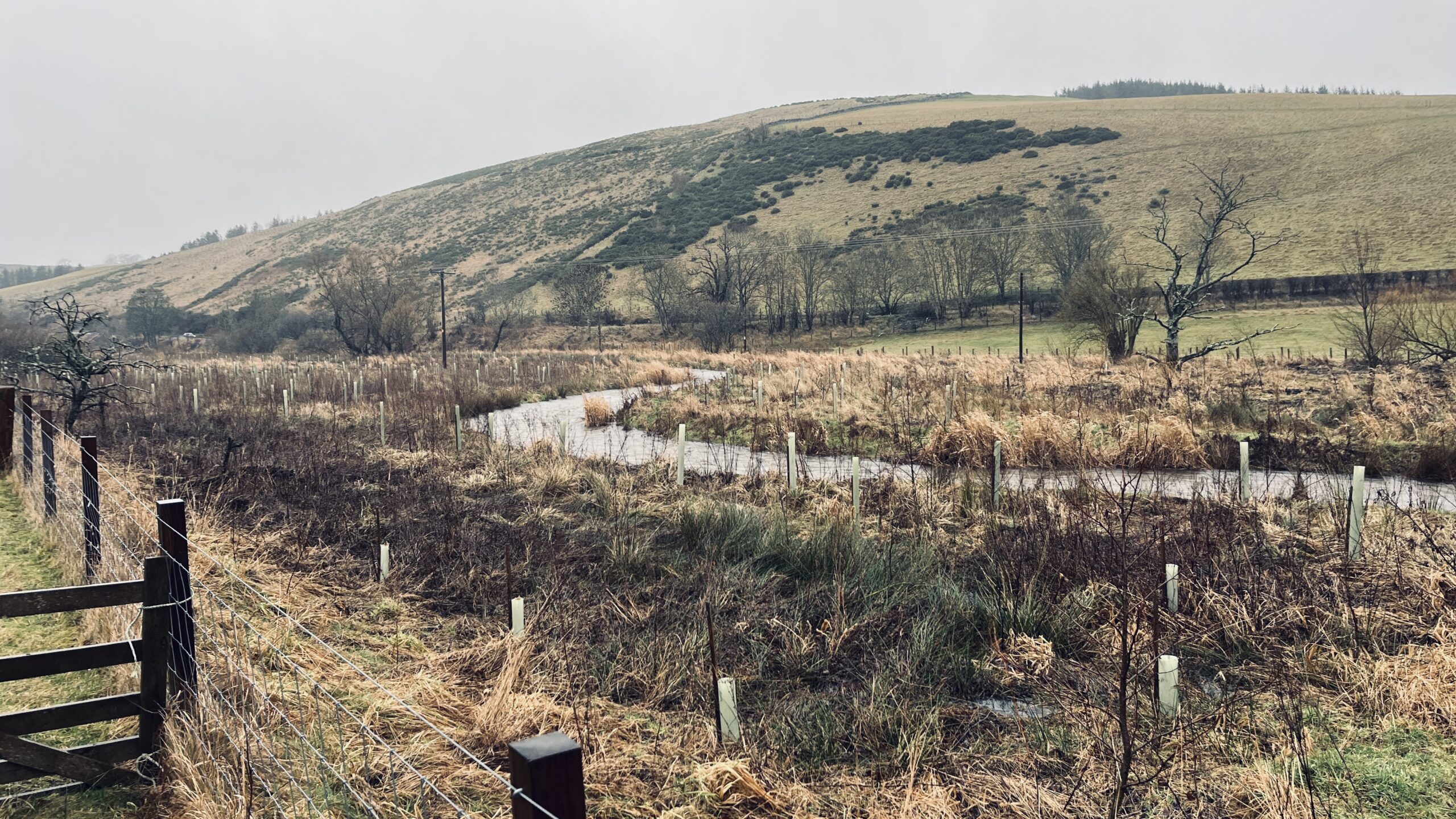
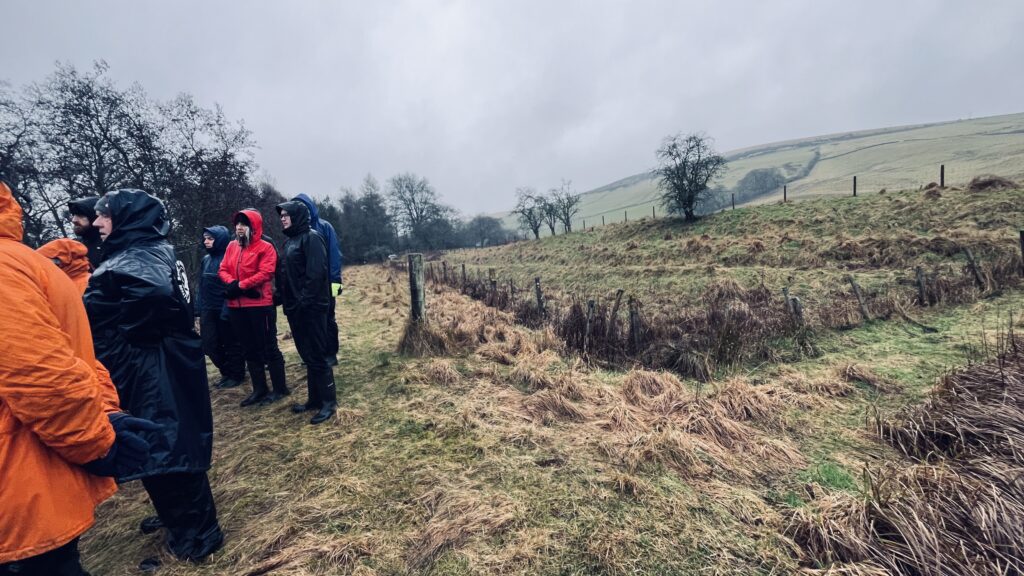
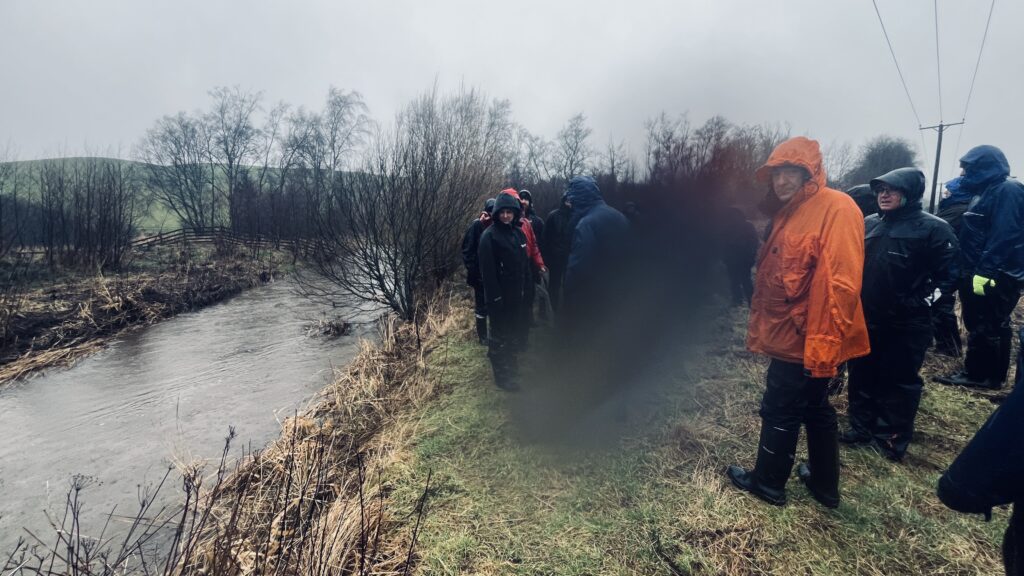
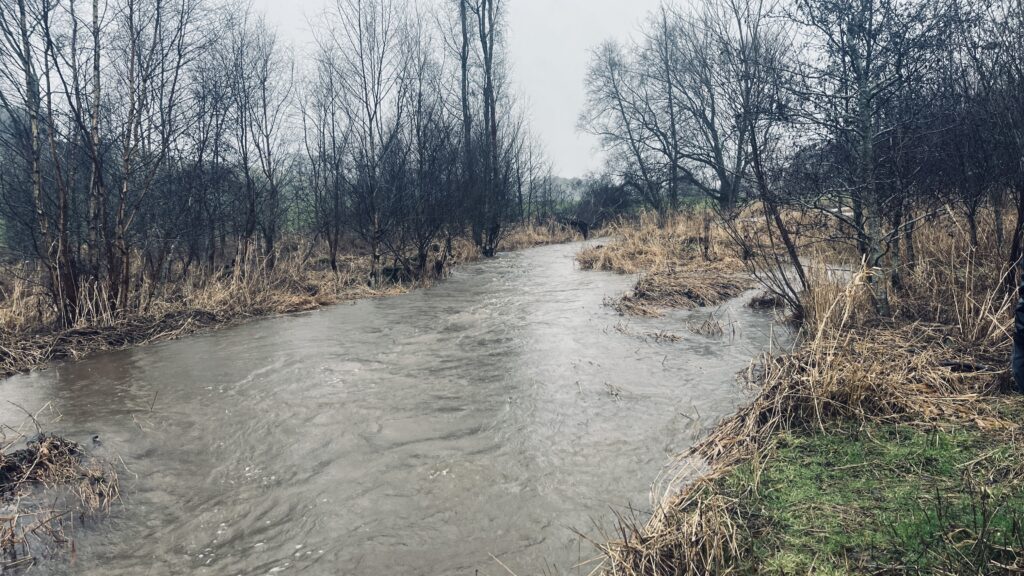
Several of us visited the Eddleston Water Natural Flood Management (NFM) project during a sustained rainfall event, which made the outcomes unusually tangible: over a few hours we could watch river levels rise while seeing how different interventions plausibly delayed and reshaped the flood response, through additional storage capacity. The project matters because, prior to around 2009, the evidence base for NFM was limited and often anecdotal. Eddleston was deliberately established as a long-term research catchment to generate robust hydrological, ecological and economic data at scale, rather than relying on isolated demonstration measures .
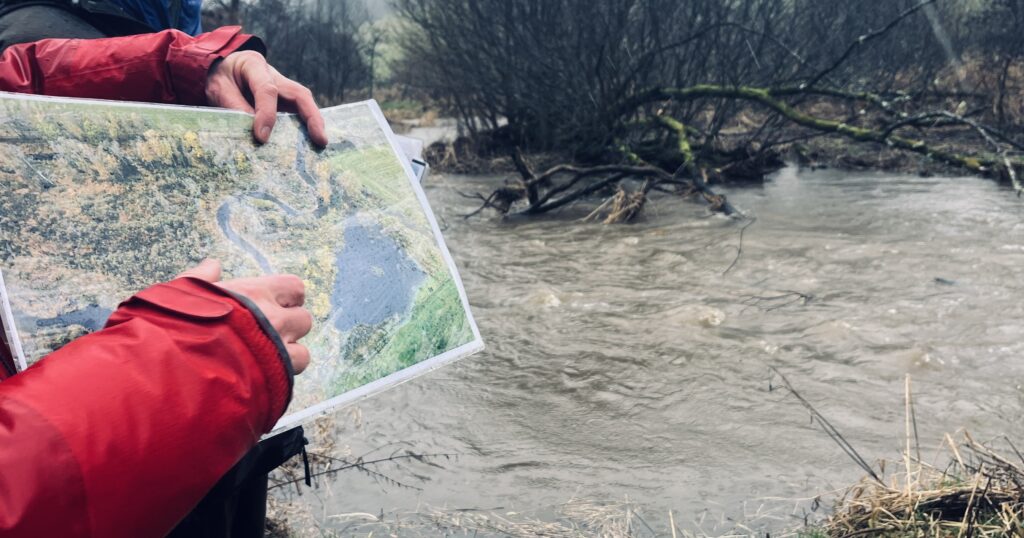
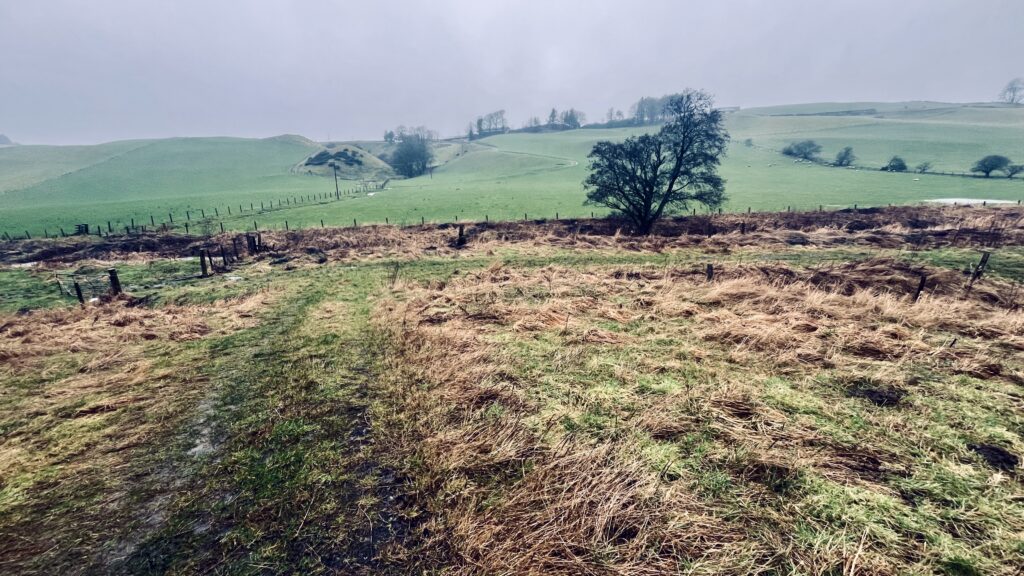
The work is also interesting because it was delivered almost entirely through voluntary cooperation with landowners, with no compulsory agreements and limited changes to land use. This inevitably shaped and constrained what could be achieved. Not all landowners participated, and some important locations that logically could have been included, were unavailable. That reflecting the priorities of predominantly grassland farming businesses where retaining productive land is considered economically or traditionally important. Also, large parts of the catchment — including much improved grassland and even broader expanses of unimproved grassland and commercial conifer forestry — remain largely untreated. Even so, the combined effect of re-meandering, floodplain reconnection, woody debris structures, ponds and tree planting has been to measurably delay flood peaks and reduce their intensity. In the upper catchment, peak flows for smaller events have reduced by around 30%, with lag times increased by several hours; at whole-catchment scale, NFM demonstrably delays floods rather than preventing them outright .
The historical context is critical. Extensive modification of the Eddleston Water began early in the nineteenth century to accommodate the Peebles–Edinburgh road, later compounded by railway infrastructure and agricultural drainage, resulting in a simplified channel form and widespread disconnection from the floodplain. Much of the downstream flood risk has also been intensified by development from the 1960s onwards on land that is now recognised as functional floodplain, embedding exposure that cannot realistically be addressed by river restoration alone. This pattern is typical of many Scottish and UK catchments.
Importantly, the river’s long-standing failure to achieve “good” ecological status under the Water Framework Directive was not driven by poor chemical water quality, which is generally good. The principal limiting factors were hydromorphological alteration and ecological degradation — straightening, embankment, loss of habitat diversity and impaired biological communities — rather than pollution in the conventional sense – though this would remain a factor.
Re-meandering has proved both visually striking and ecologically effective, but Professor Spray has consistently cautioned that even substantial reductions in flood magnitude (around 40% under some modelled scenarios) are likely to be outweighed by projected climate-driven increases in flood risk, cited at over 50%. NFM reduces damage and buys time; it does not offer absolute protection or climate proofing. Where the balance shifts decisively is when wider ecosystem services are included. Biodiversity gains, carbon storage, water quality improvements and recreation benefits together substantially outweigh flood-damage avoidance alone, with total benefits several times greater than costs over the long term.
What this means for smaller catchments
Although our local catchments are appreciably smaller than the Eddleston Water, they share many of the same constraints: historic channel modification, floodplain disconnection, intensive land use and limited room for large-scale interventions. The Eddleston evidence suggests that, in such settings, natural flood management is most effective at delaying flood peaks and reducing their intensity rather than preventing flooding outright. In smaller catchments, response times may be shorter, but proportionately modest measures — if well placed — can still deliver meaningful benefits, particularly when combined across the catchment.
Crucially, the wider ecosystem benefits observed at Eddleston — improved habitat quality, increased biodiversity and carbon storage — are not scale-dependent in the same way as flood attenuation. Even where flood risk reduction is limited by space and past development, these co-benefits can still justify intervention, provided expectations remain realistic and landowner engagement is sustained.
Social and economic constraints remain decisive. Their surveys suggest that a good proportion of the landowning community could support more extensive measures with the right incentives and for areas, which are smaller than private nature-capital investors might consider1.
The Eddleston project therefore stands less as a universal template, and more as a rigorous demonstration of what NFM can and cannot deliver within real-world planning, land-use and ownership constraints.
- They mostly seek larger, contiguous areas with long-term legal certainty — conditions that a voluntary, piecemeal approach cannot readily provide ↩︎