
If you missed this session, here’s some quick takeaways (a 5 minute read) of this 52m hour webinar. It will save you a bit of time and cut through the dry presentation facts.
Scotland’s Farm Advisory Service ran a webinar on 23 July on planning for water scarcity in grazing systems, with Kerr Adams of the James Hutton Institute and Alec Pirie, senior agricultural consultant with SAC Consulting. It is on the FAS YouTube channel and worth an hour of anyone’s evening. Here is our shorter version, and what it does and doesn’t tell us about our patch.
The measure that matters is the balance, not the rainfall
Adams framed everything around the climatic water balance: rainfall in, minus evapotranspiration out. When plants and warm air pull out more than the sky puts in, you are in deficit, whatever the annual rainfall total says.
Comparing 1990–2019 against a 1960–1989 baseline, the pattern is a wetter January and February, a drier September, and — the part that gets less attention — more water lost to evapotranspiration in almost every month across almost all of Scotland. As every farmer knows, excess rain arriving in winter when the ground can’t hold it, doesn’t help grass in July.
Looking forward to around 2050, the modelled picture is a water balance deficit running roughly May to September, with knock-on effects on grass growth, stocking rates, bought-in winter forage, and livestock drinking water.
A caveat worth keeping. Adams was straight about his own numbers. The projections he showed were the worst-case emissions pathway (RCP8.5), drawn from twelve different climate models with real variation between them, built on 2018 UK projections that are now due a refresh. Asked directly whether 8.5 is where we are heading, he said he suspects it is no longer realistic and that business-as-usual may sit closer to RCP6. He chose the worst case deliberately, to plan against. Read the maps as a stress test, not a forecast.
What it looks like on the ground
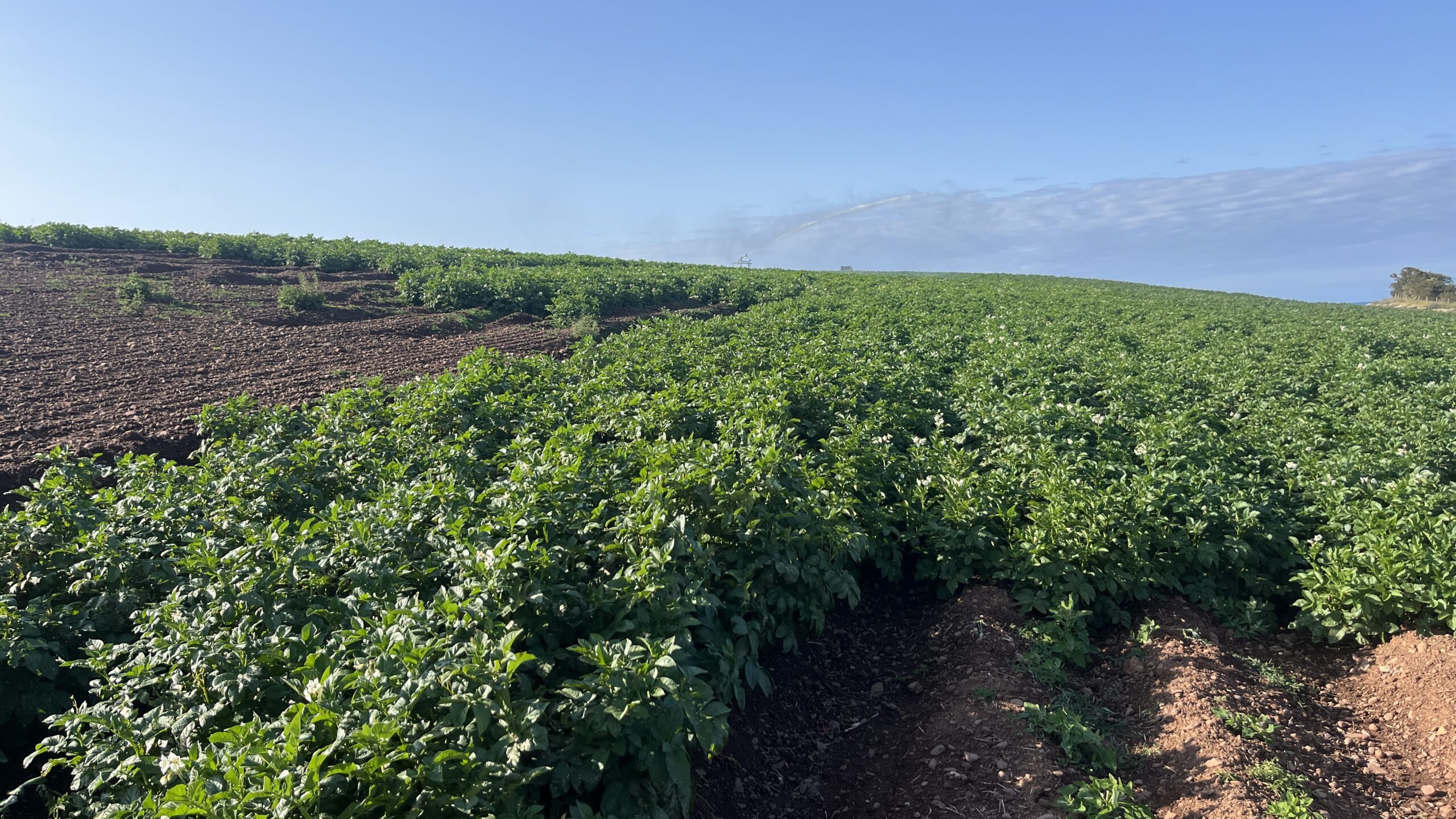
Pirie’s list came from his own farmer clients, and it is recognisable: hill burns drying up, grass stopping in June just when the post-silage flush is wanted, troughs filled by bowser where an abstraction point used to do the job, potato irrigation under strain.
The one to watch for our local catchments might well be poaching. As stock get more determined to reach water, banks get churned, the vegetation layer dies back, and the next rain washes soil and sediment straight into the burn. Wetting and drying cycles make those exposed soils more mobile still. Water scarcity and diffuse pollution turn out to be the same problem viewed from different ends.
He also explained the abstraction rules plainly, which is useful because they are widely misunderstood. A temporary suspension is triggered when the five-day mean flow sits below Q95 — the flow exceeded 95% of the time — for 30 consecutive days. It exists to protect the ecology and other users, not to inconvenience anyone.
What can actually be done
Nothing on Pirie’s list is exotic:
- Water margin management. Either you have no fencing and are getting poaching, or you have fencing and have stopped thinking about what is on the other side. Both need a plan.
- Alternative watering — nose pumps, solar pumps, piped systems, troughs. Fundable under AECS, along with the water transfer infrastructure.
- Trees for shade and structure. Shelter belts, riparian woodland, the awkward wet corner nobody farms well. Shade for stock, cooler water for fish, root systems holding banks.
- Rainwater harvesting and reuse. Dairy units in the southwest already do this well, diverting plate cooler water to parlour washing. It is free water falling on a roof.
- Peatland restoration. Pirie described himself as a former sceptic now converted, on the strength of better water availability on the hill and more birds using it.
On collaboration, his view was that rainwater harvesting is a solo job but peatland restoration is a no-brainer to do jointly, and AECS already has a mechanism rewarding collaborative applications.
The bit we still need
None of the detailed mapping covered us. The four regions Adams walked through were Dumfries & Galloway, south Ayrshire, north Ayrshire and Argyll — the wet side, where scarcity is the newer story. The east has been the drier side all along, so the direction of travel is not in doubt, but the local numbers are simply not in that presentation.
Two openings from the webinar are worth taking up. Adams offered, more than once, to provide equivalent figures for other regions to anyone who gets in touch. And the Hutton has a 1km-grid portal in prototype that would let a farm look up its own indicators directly. We might well want to ask.
Useful Water management links from FAS and CREW
Sources and follow-up: the webinar recording is on the Scotland’s Farm Advisory Service YouTube channel. FAS offers specialist water advice plans to holdings with a registered BRN, covering water availability, diffuse pollution assessment and flood management. Farming and Water Scotland, a joint SAC Consulting and SEPA initiative, holds an archive of related material. SEPA publishes a water scarcity assessment updated through spring and summer.